Seaway Site

Formerly Utilized Sites Remedial Action Program (FUSRAP)

U.S. Army Corps of Engineers, Buffalo District
Published Dec. 11, 2023
Updated: April 16, 2026
Work at the U.S. Army Corps of Engineers, Buffalo District, FUSRAP Seaway site

The U.S. Army Corps of Engineers, Buffalo District, holds a public information session on the FUSRAP Seaway site, Tonawanda, New York, April 18, 2024.

Construction equipment driving over the FUSRAP Seaway Site as the engineered cap nears completion.

The U.S. Army Corps of Engineers, Buffalo District conducted a site visit at the Formerly Utilized Remedial Action Program (FUSRAP) Seaway site and viewed the progress as the engineered cap nears completion, Tonawanda, NY, Nov. 1, 2025. Under FUSRAP, USACE is cleaning up sites with contamination resulting from the Nation’s early atomic energy program providing ecological and economic benefits across the Nation. (U.S. Army photo by Joe Paulin)

Restoration activities including drainage measures and installing erosion control bio-fabric.

The U.S. Army Corps of Engineers, Buffalo District conducted a site visit at the Formerly Utilized Remedial Action Program (FUSRAP) Seaway site and viewed restoration activities including drainage measures and installing erosion control bio-fabric, Tonawanda, NY, Oct. 1, 2025. Under FUSRAP, USACE is cleaning up sites with contamination resulting from the Nation’s early atomic energy program providing ecological and economic benefits across the Nation. (U.S. Army photo by Joe Paulin)

Drilling of soils samples at the southside area and sample preparation for shipment to the lab for testing

The U.S. Army Corps of Engineers, Buffalo District conducted a site visit at the Formerly Utilized Remedial Action Program (FUSRAP) Seaway site and viewed the drilling of soils samples at the southside area and sample preparation for shipment to the lab for testing, Tonawanda, NY, Jul. 23, 2025. Under FUSRAP, USACE is cleaning up sites with contamination resulting from the Nation’s early atomic energy program providing ecological and economic benefits across the Nation. (U.S. Army photo by Joe Paulin)

Engineered cap inspection by two Buffalo District engineers.

The U.S. Army Corps of Engineers, Buffalo District conducted a site visit at the Formerly Utilized Remedial Action Program (FUSRAP) Seaway site and inspected the engineered cap, Tonawanda, NY, May 1, 2025. Under FUSRAP, USACE is cleaning up sites with contamination resulting from the Nation’s early atomic energy program providing ecological and economic benefits across the Nation. (U.S. Army photo by Joe Paulin)

Inspection and viewing of the stormwater control installation a the Seaway Site.

The U.S. Army Corps of Engineers, Buffalo District conducted a site visit at the Formerly Utilized Remedial Action Program (FUSRAP) Seaway site and had an inspection and viewed the stormwater control installation, Tonawanda, NY, May 1, 2025. Under FUSRAP, USACE is cleaning up sites with contamination resulting from the Nation’s early atomic energy program providing ecological and economic benefits across the Nation. (U.S. Army photo by Joe Paulin)

Graphic representation of the Seaway site in Tonawand, NY.

The U.S. Army Corps of Engineers, Buffalo District Formerly Utilized Remedial Action Program (FUSRAP) Seaway site location map, Tonawanda, NY, May 2025. Under FUSRAP, USACE is cleaning up sites with contamination resulting from the Nation’s early atomic energy program providing ecological and economic benefits across the Nation. (U.S. Army photo by Joe Paulin)

Work at the U.S. Army Corps of Engineers, Buffalo District, FUSRAP Seaway site

Work is prepared to begin at the U.S. Army Corps of Engineers, Buffalo District, FUSRAP Seaway site, Tonawanda, New York, April 2024.

Work at the U.S. Army Corps of Engineers, Buffalo District, FUSRAP Seaway site

Work is prepared to begin at the U.S. Army Corps of Engineers, Buffalo District, FUSRAP Seaway site, Tonawanda, New York, April 2024.

Work at the U.S. Army Corps of Engineers, Buffalo District, FUSRAP Seaway site
PHOTO DETAILS  /   DOWNLOAD HI-RES 10 of 18

Work is prepared to begin at the U.S. Army Corps of Engineers, Buffalo District, FUSRAP Seaway site, Tonawanda, New York, April 2024.

Work at the U.S. Army Corps of Engineers, Buffalo District, FUSRAP Seaway site
PHOTO DETAILS  /   DOWNLOAD HI-RES 11 of 18

Radon attenuation layer operations continue at the U.S. Army Corps of Engineers, Buffalo District, FUSRAP Seaway site, Tonawanda, New York, June 4, 2024.

Work at the U.S. Army Corps of Engineers, Buffalo District, FUSRAP Seaway site
PHOTO DETAILS  /   DOWNLOAD HI-RES 12 of 18

A geosynthetic fabric liner is installed at the U.S. Army Corps of Engineers, Buffalo District, FUSRAP Seaway site, Tonawanda, New York, June 24, 2024.

Work at the U.S. Army Corps of Engineers, Buffalo District, FUSRAP Seaway site
PHOTO DETAILS  /   DOWNLOAD HI-RES 13 of 18

A geosynthetic fabric liner is inspected at the U.S. Army Corps of Engineers, Buffalo District, FUSRAP Seaway site, Tonawanda, New York, June 25, 2024.

Work at the U.S. Army Corps of Engineers, Buffalo District, FUSRAP Seaway site
PHOTO DETAILS  /   DOWNLOAD HI-RES 14 of 18

A geosynthetic fabric liner is installed at the U.S. Army Corps of Engineers, Buffalo District, FUSRAP Seaway Site, Tonawanda, New York, July 20, 2024.

Work at the U.S. Army Corps of Engineers, Buffalo District, FUSRAP Seaway site
PHOTO DETAILS  /   DOWNLOAD HI-RES 15 of 18

Radon attenuation layer operations continue at the U.S. Army Corps of Engineers, Buffalo District, FUSRAP Seaway site, Tonawanda, New York, July 24, 2024.

Work at the U.S. Army Corps of Engineers, Buffalo District, FUSRAP Seaway site
PHOTO DETAILS  /   DOWNLOAD HI-RES 16 of 18

Radon attenuation layer operations continue at the U.S. Army Corps of Engineers, Buffalo District, FUSRAP Seaway site, Tonawanda, New York, July 24, 2024.

Work at the U.S. Army Corps of Engineers, Buffalo District, FUSRAP Seaway site
PHOTO DETAILS  /   DOWNLOAD HI-RES 17 of 18

A geosynthetic fabric liner is installed and compacted at the U.S. Army Corps of Engineers, Buffalo District, FUSRAP Seaway Site, Tonawanda, New York, July 25, 2024.

Work at the U.S. Army Corps of Engineers, Buffalo District, FUSRAP Seaway site
PHOTO DETAILS  /   DOWNLOAD HI-RES 18 of 18

A gas vent is assembled and installed at the U.S. Army Corps of Engineers, Buffalo District, FUSRAP Seaway site, Tonawanda, New York, July 29, 2024.

About the Seaway Site


Location

The site is located along River Road in Tonawanda, NY, within the 100-acre Seaway Industrial Park, near the Grand Island Bridge.


Background

  • During the 1940s, waste from the former Linde Site's nuclear weapons program activities were stored at a property known as the Ashland 1 site (adjacent to the Seaway Site).
  • In 1974, some of those materials were moved from the Ashland 1 Site and disposed of in the Seaway Site.
  • In 1993, disposal to the Seaway landfill ended and a portion of the landfill was capped per state requirements.


The Remedial Design


Areas A, B, and C:

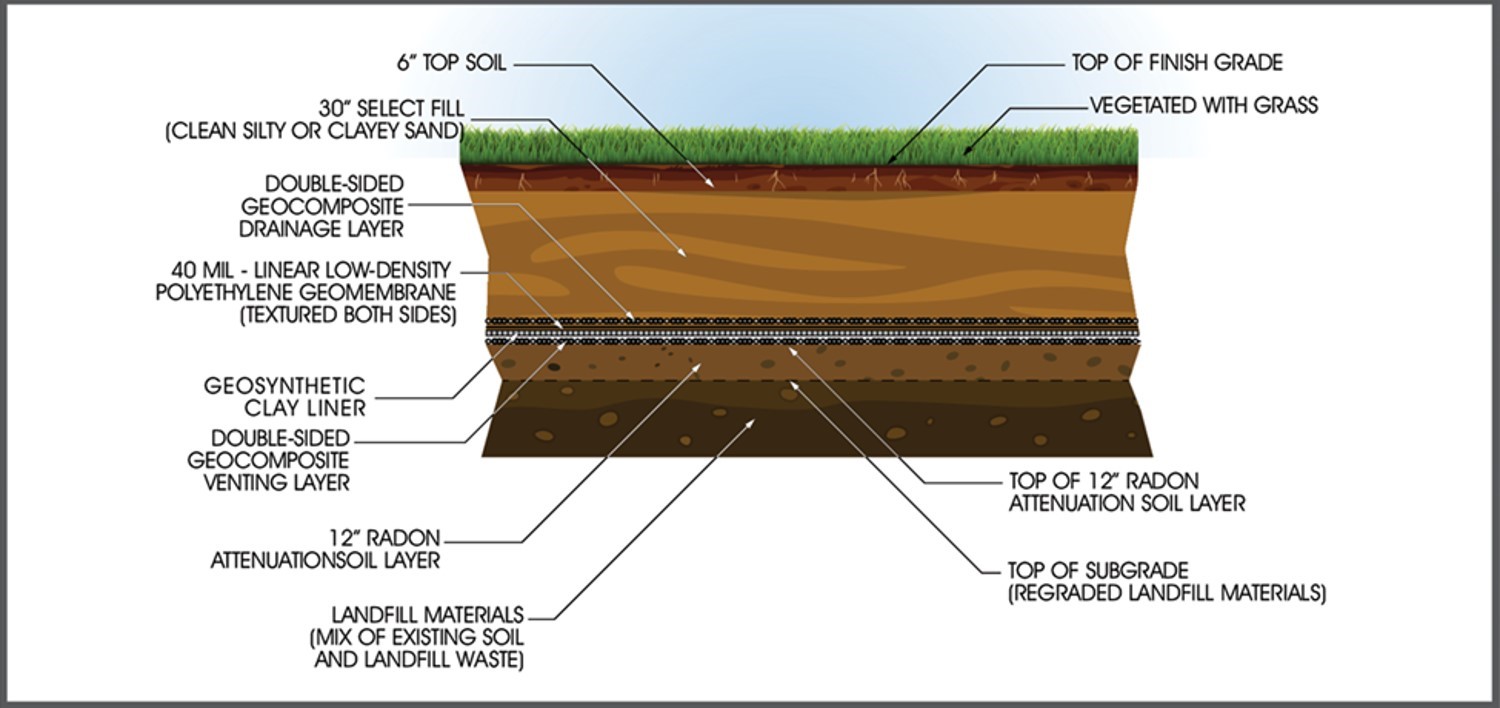
The FUSRAP-contaminated material in areas A, B, and C have been covered with an engineered cap that measures about 22-acres in size and about 5-feet thick. This engineered cap is designed to safely contain the FUSRAP-contaminated material and consists of the following layers:

  1. Radon attenuation layer: This is placed first and directly on top of the landfill waste. It is composed of soil with specific moisture and compaction properties to limit radon movement through the engineered cap.
  2. Gas venting layer: A permeable layer designed to conduct landfill gas to passive surface vents.
  3. Barrier layer: A geosynthetic clay liner and geomembrane designed to limit surface water infiltration to the waste below.
  4. Subsurface drainage layer: A geocomposite layer designed to safely conduct surface water that infiltrates the fill later to drainage outlets.
  5. Select fill layer: Clean imported fill designed to prevent damage to the barrier layer.
  6. Topsoil layer: Used to promote vegetative growth and prevent erosion of the engineered cap.


Areas not included in the remedial design

Seaway Area D: Remediated under the Record of Decision for the adjacent Ashland site in 2000.

Seaway Northside: Remediated in 2015.

Seaway Southside: Remedial action not yet completed. USACE is reviewing data to support the planning and design of potential future remediation.


Community Involvement & Project Status


Community Engagement

U.S. Army Corps of Engineers (USACE) engaged with the community in March and April 2024, including a public information session on April 18, 2024.


Contract and Scope

In September 2023, USACE awarded a $17.6 million contract to install a 22-acre engineered cap over Areas A, B, and C of the Seaway Site.


Site Preparation and Safety

By late April 2024, equipment staging, site preparation, and safety measures (including air monitoring) were completed. Air monitoring began 30 days before remedial work and continued through the completion of the radon attenuation layer in August 2024.


Construction

Construction of the engineered cap began on April 30, 2024, and was completed in December 2025.


Seaway Site Timeline


Year Event
1974–1997 Atomic Energy Commission (AEC)/U.S. Department of Energy (DOE) managed FUSRAP; surveys and investigations conducted at Tonawanda properties, including Seaway.
1993 DOE completed a Remedial Investigation (RI) and Feasibility Study (FS) and issued a Proposed Plan (PP) for on-site disposal of contaminants.
1994 DOE suspended decision-making to re-evaluate alternatives due to community concerns.
1998 FUSRAP responsibility transferred from DOE to USACE under the Fiscal Year 1998 Energy and Water Development Appropriations Act (Pub. L. 105-62); separate plans and decisions issued for other Tonawanda sites.
2008 USACE issued a Feasibility Study addendum and revised Proposed Plan, identifying contaminated soils and confirming groundwater/leachate were not impacted.
2009 Record of Decision (ROD) approved; selected remedy was containment with limited off-site disposal, including capping and excavation.
2016 USACE completed excavation and off-site disposal of contaminated soil from Seaway Northside.
2017 USACE delineated contamination in Seaway Southside.
2021 Contract awarded for engineered cap design and planning.
2022 First five-year review of the selected remedy completed in accordance with Comprehensive Environmental Response Compensation and Liability Act (CERCLA) requirements.
2023 Contract awarded for engineered cap installation.
2024 Installation of the engineered cap began.
2025 Engineered cap completed in December 2025.


Key Documents

Key documents are available at the Project Assistance Library (PAL).


Sources of Additional Information


News from the Corps

Subscribe to periodic updates by emailing fusrap@usace.army.mil.


Contact Information

Phone: 1-800-833-6390 (Option 4)

Email: fusrap@usace.army.mil

Address:
U.S. Army Corps of Engineers, Buffalo District
478 Main Street
Buffalo, NY 14202